science
View full archive →Research, discovery, and the natural world.

UC Santa Barbara researchers use AI to make 96-electrode brain implant more predictable in one blind man
Researchers at UC Santa Barbara used a deep-learning model to tune a 96-electrode visual-cortex implant in one blind man, producing more predictable light patterns than preset stimulation. Published in Neuron, the proof-of-concept study shows AI may make cortical vision prostheses more personalized and reliable. It matters because people blinded by eye, optic-nerve or brain-related damage need devices that create usable, consistent visual cues.

Pompeu Fabra researchers report vaccination prevented lasting spleen damage and immune impairment in mice after viral infection
Pompeu Fabra University researchers reported in Cell Death & Disease that acute viral infection caused persistent spleen scarring and impaired T-cell responses in mice, while prior vaccination prevented the damage. The finding matters because it suggests vaccines may protect not only against illness but also against lasting immune-system dysfunction.

Renewable energy cost decline seen outweighing COP31 pledges in net-zero transition
The article argues that falling renewable energy costs are becoming the decisive force behind the net-zero transition, even as COP31 diplomacy shows limited enthusiasm for phasing out fossil fuels. This matters because lower clean-energy prices can reshape investment, utility choices and national policies faster than summit pledges alone.

Theoretical physicists propose dark energy sign flip 9.5 billion years ago
An international team led by Istanbul Technical University showed in Physical Review D that a modified gravity model can make dark energy's effective density flip from negative to positive about 9.5 billion years ago without adding parameters. The result matters because it offers a concrete theoretical alternative to constant dark energy and connects to observational hints that dark energy may evolve. It would affect cosmology only if future data confirm such a change.

NASA Perseverance confirms organic carbon in two ancient Martian rocks
NASA's Perseverance rover has confirmed organic carbon in two ancient Martian rocks in Jezero crater, detecting it just microns below the surface. The finding shows that carbon-bearing material can survive in harsh near-surface environments and gives scientists a better target for analyzing possible biosignatures. It does not prove life existed on Mars, but it strengthens the case that Mars preserved clues to its ancient habitability.
Robot assembles radio antenna in orbit without astronauts in first autonomous space construction
Researchers say a robot has autonomously assembled a radio antenna in orbit without astronauts, a first for in-orbit construction. The demonstration shows that space hardware can be built after launch rather than only unfolded, which matters for satellites, repairs and future orbital infrastructure.
AI-powered proof confirms quantum computers offer no huge advantage for broad problem class
An AI-generated proof has confirmed a long-standing conjecture that quantum computers cannot deliver large advantages for a broad class of mathematical problems, New Scientist reported. The result is mathematical rather than experimental, but it narrows where quantum speedups can be expected. It matters because it disciplines claims about quantum computing's practical reach and helps separate bounded problem classes from areas where advantage may remain real.
Pink noise during sleep improved memory in early Alzheimer's study
Pink noise played during sleep may improve memory in people with Alzheimer's, according to early research reported by New Scientist. The finding builds on evidence that sleep-related sound cues can support brain waste clearance. The evidence remains preliminary and needs larger randomized trials.
NASA Mars analog crew completes more than a year in isolation
Four NASA volunteers completed a more-than-year CHAPEA Mars analog mission on Oct. 31, 2026, after operating under communication delays and simulated spacewalks. The program provides controlled human-performance data for Moon and Mars planning, but its small Earth-based sample cannot reproduce all deep-space hazards.

European Space Agency's Euclid telescope releases vast new image data of distant star-forming galaxies
Euclid released a large new set of images showing distant star-forming galaxies. The data add to the telescope's wide survey, which is used to study galaxy growth and broader cosmic structure. The release matters because large, uniform observations can improve statistical maps of the universe, though final conclusions depend on later analyses.
MIT-led Lumina simulation maps 2 billion years of cosmic dawn across 1.6 billion light-years
Researchers at MIT, Harvard and other institutions released Lumina, a simulation that follows 2 billion years of cosmic history across 1.6 billion light-years. It models hydrogen and helium reionization together for the first time, showing early stars cleared hydrogen while feeding black holes supplied more energetic radiation for helium. The simulation gives astronomers a larger, more complete framework for comparing theory with telescope observations of the universe's first light.

Animal study finds blood-thinning drug reduced cartilage damage and osteoarthritis pain
A preclinical animal study reports that a blood-thinning drug reduced cartilage damage and pain-related outcomes in osteoarthritis. The result is notable because no approved drugs currently slow osteoarthritis development, but the evidence is not yet human and lacks key methodological details. It points to clotting-related biology as a possible treatment target.

Researchers find no male protein in 23 Homo naledi teeth, raising female-only burial possibility
Ancient protein analysis of Homo naledi teeth detected no male-specific marker, opening a debate over whether a South African cave held a female-only burial group. If supported, the result would suggest complex social or mortuary behavior in a human relative other than Homo sapiens. The claim remains uncertain because the same protein could have been lost through mutation, gene loss, or preservation bias.

NASA says 2026 Antarctic ozone hole reached 10.5 million square miles, decade high
NASA and NOAA reported that the 2026 Antarctic ozone hole peaked at 10.5 million square miles, a decade high, and averaged 9.6 million square miles during the seasonal peak. Scientists linked the expansion to an unusually strong polar vortex, while saying the ozone layer is still recovering and the hole would have been larger without chemical cuts. The episode matters because it shows how weather can amplify a seasonal environmental risk even as long-term protections limit the damage.

River monitoring finds two restricted PFAS declining in English waterways as replacements appear
New Scientist reports that two restricted PFAS are declining in English rivers while replacement PFAS appear. The finding shows regulation can reduce named forever chemicals but may leave exposure to less studied substitutes. It matters for waterways and communities facing ongoing PFAS contamination.
Swedish researchers point to TRL and Lp(a) as residual heart disease risk beyond LDL
Chalmers researchers used proteomics to examine how LDL, TRL and Lp(a) contribute to coronary heart disease, highlighting mechanisms that may persist after LDL cholesterol is lowered. The findings add nuance to cardiovascular risk assessment for people whose bad cholesterol is controlled but who still face heart attack or stroke risk.
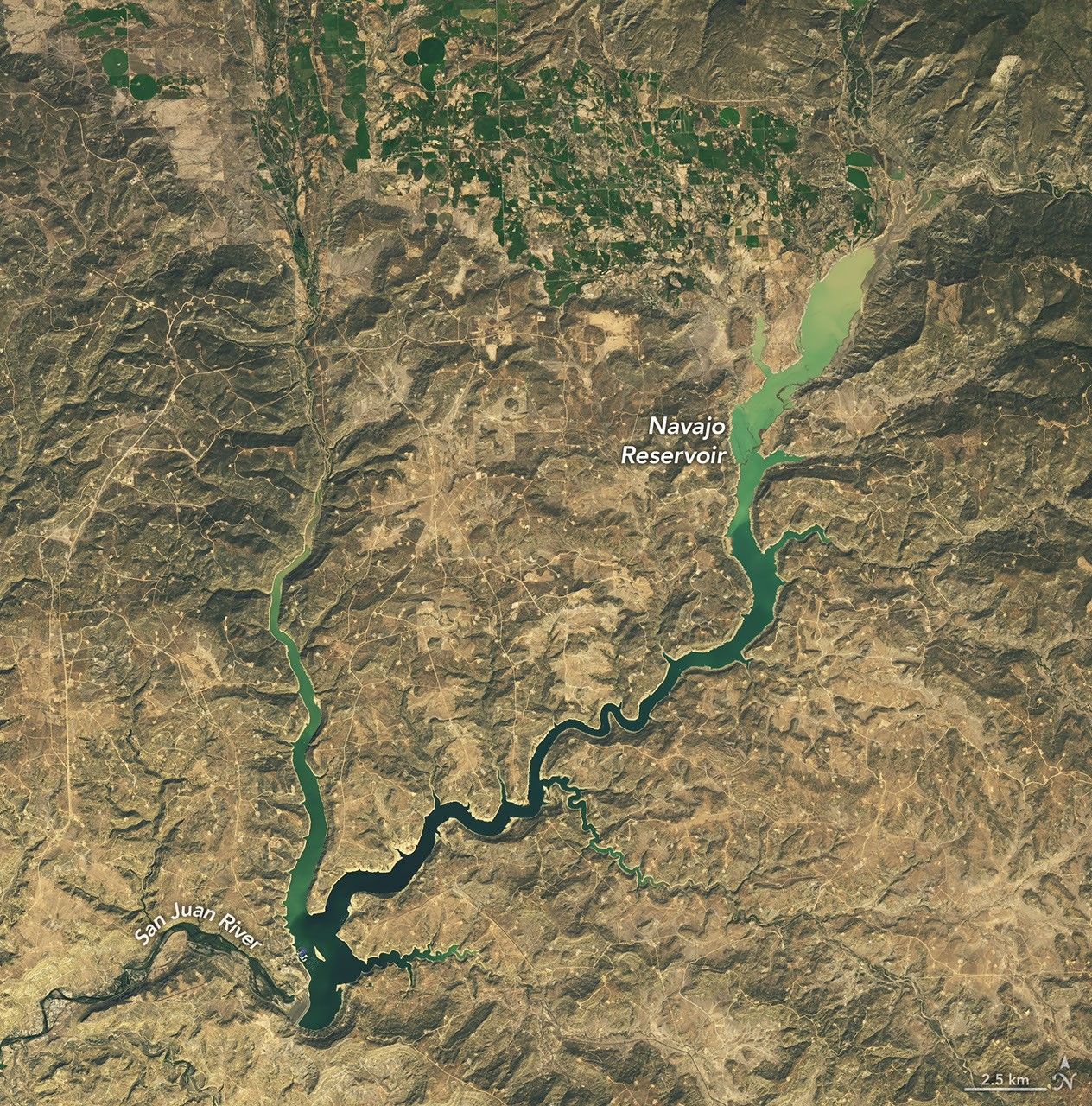
Back-to-back storms lift Navajo Reservoir nearly 60 feet in under two months
Back-to-back storms raised Navajo Reservoir by nearly 60 feet in under two months, lifting it from 60% to 108% of average capacity. The surge ended short-term drought in the Southwest and Great Basin but caused severe flooding in Four Corners communities. It shows how quickly water scarcity and flood risk can alternate in a drought-prone region.
Researchers simulate bosonic tunneling on IBM and IonQ processors with 200-gate circuits
A preprint compares binary and unary encodings for simulating bosonic position dynamics on IBM and IonQ quantum processors. Short unary circuits reproduced tunneling in a double-well benchmark, while deeper binary product-formula circuits failed. The result matters because encoding and compilation choices may let current noisy quantum devices tackle small physical simulations that are hard to run classically.
Researchers report first seven-month borehole seismic data from Einstein Telescope Meuse-Rhine site
Researchers report first borehole seismic data from the Einstein Telescope's Euregio Meuse-Rhine candidate site, covering seven months in 2026 across four underground stations and surface sensors. The results catalogue transients, including railway-induced noise, and feed models that predict Newtonian noise for detector siting and mitigation. The work matters because low-frequency gravitational-wave detection depends on controlling ground motion and local human activity.
NASA-funded STARI mission plans first in-space transfer of starlight between free-flying spacecraft
NASA-funded STARI is a two-spacecraft technology demonstrator that would transfer starlight between free-flying CubeSats for the first time. The mission matters because long-baseline space interferometry could eventually image exoplanets and stellar surfaces at resolutions single telescopes cannot reach. Its evidence is currently a preprint mission design, so flight validation remains the decisive test.