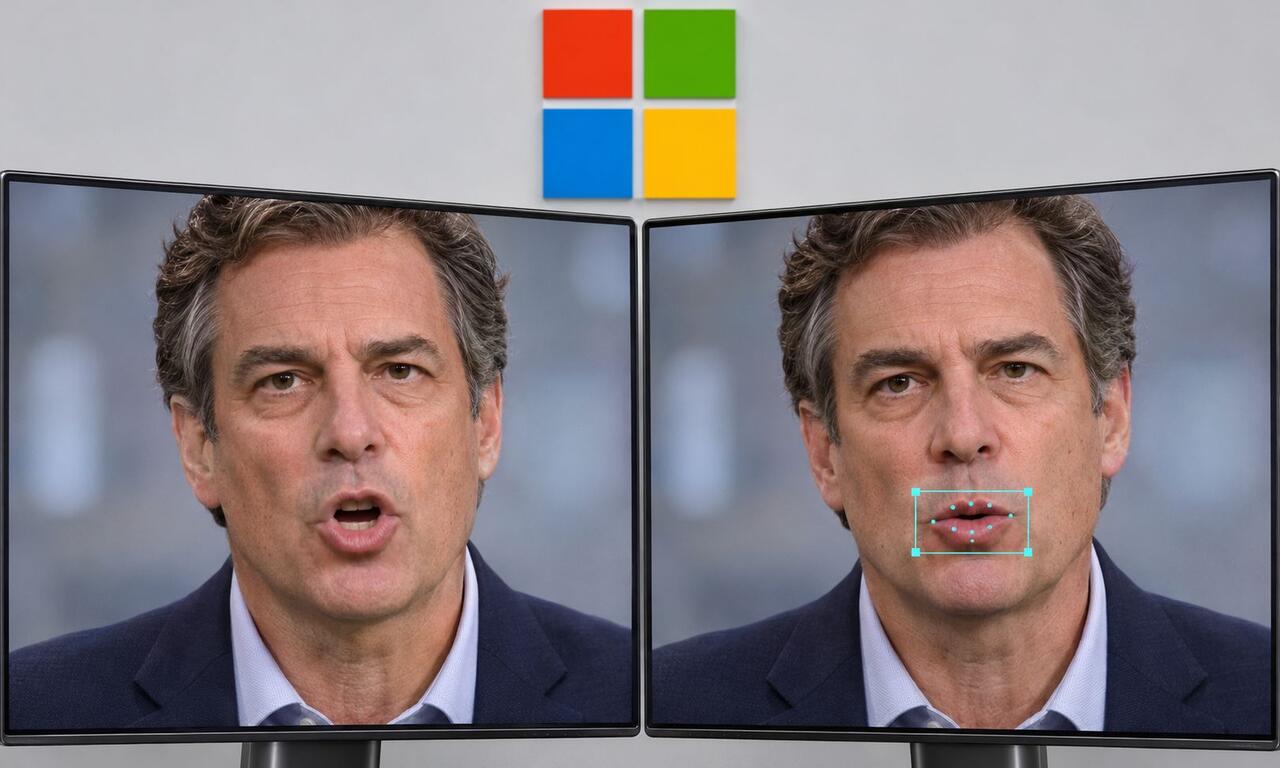
Microsoft’s Filing Describes AI That Rewrites Live Speech and Redraws the Lips
A published Microsoft patent application, not a product, describes near-real-time AI that swaps words in live video based on a viewer profile — including religion, ethnicity, and education — and redraws the speaker’s lips to match, with the original stored only as operator-side “ground truth.”
Watch the short version
Documented, not deployed: on October 29, 2026 the U.S. Patent and Trademark Office published application US 2026/0341309 A1, filed April 29, 2025 by Microsoft Technology Licensing, LLC, under the title “Near Real-Time Artificial Intelligence (AI) Enhancement of Video or Augmented Reality (AR) Presentations of Live Events.” Patent tracker Patentlyze, which first flagged it, and subsequent coverage in Futurism and Computerworld list the inventors as David Callaghan and Dinesh Kumar. It is a published application. It is not a granted patent, and no Microsoft product built from it has been announced. Futurism reported that Microsoft did not respond to a request for comment.
What the filing itself describes is narrower than “Microsoft wants to put words in your mouth,” and broader than a profanity bleep. An AI agent scans live audio and identifies spoken words to modify “based on a set of parameters and/or a profile of a user.” A generative system then replaces those words in both the audio and the video and builds smooth transitions around the join. “Near-real-time” is defined in the text as within a few seconds — 1 to 10 seconds is the example given — the same buffer live broadcasts already use so a human can cut a curse. In some cases the system modifies the speaker’s lips “to simulate the speaker(s) speaking the replacement words instead of the original spoken words.” The computing system can be AR eyewear, a phone, a tablet, or a camera, and the work can run on that device’s NPU, GPU, or CPU.
The profile is the part most write-ups soften. The specification says a profile may include age, spoken languages, region of birth, region of residence, ethnicity, cultural background, religion, education level, college major, and speech or video samples — of the speaker, the user, or an intended audience member. Because replacement is tied to a user profile, the architecture contemplates two people watching the same lecture, awards show, or game and receiving different sentences, with mouths redrawn to match. That is a description of a system. It is not evidence that any broadcast has been altered this way.
The words the filing treats as removable are not only slurs. The examples include fillers (“um,” “like,” “you know”), personal phrases (“dude”), colloquialisms including “y’all” and “bite the bullet,” mumbled or mispronounced words, and words labeled offensive, insensitive, or inappropriate. It also describes correcting visible and audible signs of a speech impediment, such as a lisp or a stutter, for the intended audience. In some examples, replacement wording is “retrieved from one of an Internet search or a database search of general information regarding a topic of discussion.” Secondary coverage has read that sentence as instant fact-checking. The patent does not use that phrase. Documented: a mechanism that can substitute words drawn from a search. Speculated: that the substitution would be accurate, disclosed, or limited to edits the speaker would accept.
The background of the filing frames the ordinary recording — what it calls the “exact copy” model — as the defect, because filler, dialect, and personal turns of phrase then require a skilled editor to remove. One dependent claim, claim 14, not the independent claim, says the original live video and audio “are stored as ground truth for future reference.” The published text reviewed here does not require that viewers be told an edit occurred, or that they be handed the original. The archive, as described, sits with the system.
A sibling application published the same day, US 2026/0341308 A1, from the same inventors, covers the recorded version: rewrite the transcript, rebuild the audio, redraw the lips, and in one mode condense a long talk into a shorter summary video built partly from newly generated footage. Patentlyze reported that the examiner on the live application raised objections on July 29, 2026 and rejected the claims as filed. That is a routine step in prosecution, not a finding that the idea is unreal, and headlines that say Microsoft has already “patented” the system outrun the file. Status should be read from the USPTO record, not from the verb in a headline.
The seam worth watching is a design choice already written down, not a secret product. Subtitles and conventional dubs announce themselves as mediation. A lip redraw whose stated purpose is to simulate the speaker saying the replacement words removes that cue. If the edit runs on the viewer’s own glasses or phone, the speaker and the broadcaster need not be the ones who chose the words. Claimed, and not shown: that Microsoft intends to ship this, that it would be used to deceive, or that any live feed has been rewritten this way. Documented: a Microsoft licensing entity has asked the patent office to protect a system that can do it, personalized by a profile that explicitly includes religion, ethnicity, and education, with the original kept as a reference rather than as the thing the viewer sees.
Sources (6)
- [1]USPTO application US 2026/0341309 A1 via Justia Patents(https://patents.justia.com/patent/20260341309)
- [2]Full text of US20260341309A1, Patents-Review(https://www.patents-review.com/a/20260341309-real-time-artificial-intelligence-ai-enhancement-video-or.html)
- [3]Patentlyze: Microsoft Patent: Live AI Video That Rewrites Speech(https://patentlyze.com/patent/microsoft-live-ai-video-rewrites-speech/)
- [4]Futurism: Microsoft Patents an AI That Can Literally Put Words in People’s Mouths in Real Time(https://futurism.com/artificial-intelligence/microsoft-patents-ai-words-in-peoples-mouths)
- [5]Computerworld: Microsoft files patent for AI that can alter what people say during live broadcasts(https://www.computerworld.com/article/4244752/microsoft-files-patent-for-ai-that-can-alter-what-people-say-during-live-broadcasts.html)
- [6]TechSpot: Microsoft patent filing describes AI that rewrites what people say in livestreams in real time(https://www.techspot.com/news/114477-microsoft-patent-filing-describes-ai-rewrites-what-people.html)