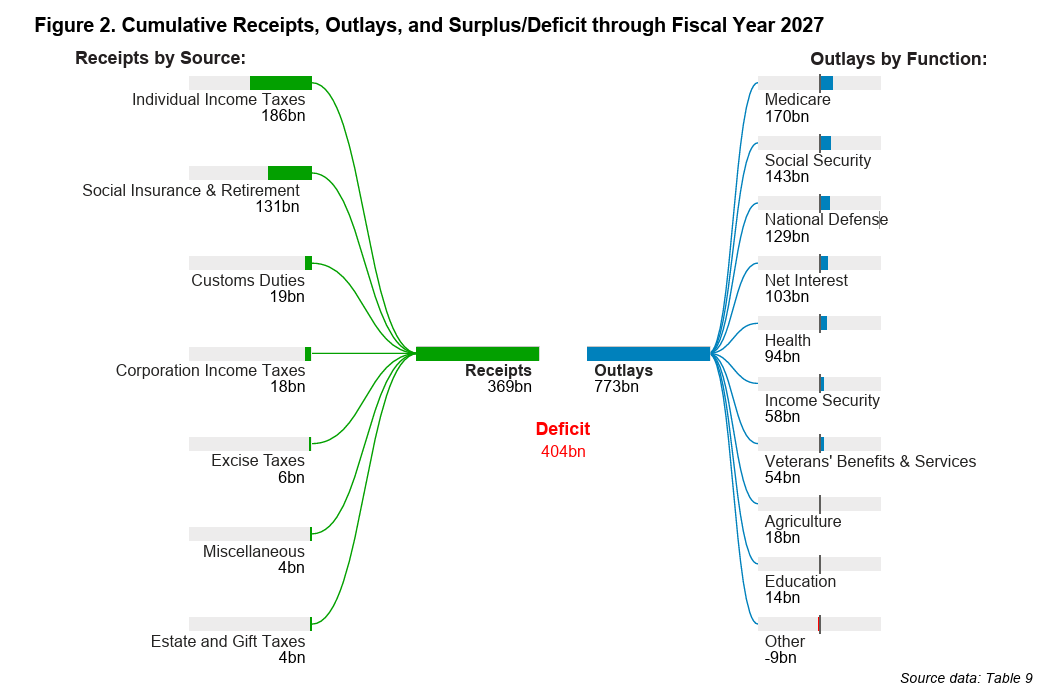
Treasury opens fiscal 2027 with a record $404 billion October deficit as interest and delayed defense payments lift outlays
Treasury’s October statement shows a record $404 billion monthly deficit to open fiscal 2027, with receipts down and outlays up on defense timing, farm aid, and interest. Full-year net interest is about a fifth of revenue, not the nearly one-third share implied by October alone.
Documented: On November 12, 2026, the Treasury Department reported a $404 billion federal budget deficit for October, the first month of fiscal 2027. Reuters, citing the monthly statement, said that was a record for October and $120 billion, or 42 percent, wider than the $284 billion gap a year earlier. Receipts were $369 billion, down about $35 billion or 9 percent. Outlays were $773 billion, up about $84 billion or 12 percent. Customs duties fell 39 percent to $19.2 billion. Gross interest on the debt rose 11 percent to $115 billion. Military outlays rose about $28 billion, or 30 percent, which Treasury and Reuters attributed in part to an October payment to military trust funds delayed by the prior government shutdown, plus higher operations, maintenance, and procurement. Farm relief lifted Agriculture Department spending. October is also a month when payments due on November 1 are pulled forward when that date falls on a weekend, so both this October and last October carried an extra batch of outlays. The year-over-year widening is therefore not only a calendar artifact, but the level of the month is inflated by timing.
The same release sits on a full year that was already large. The Congressional Budget Office’s November 9, 2026 summary put the fiscal 2026 deficit at $2.0 trillion, $217 billion or 12 percent above the prior year. Reuters reported that gap near 6.2 percent of GDP, up from 5.8 percent in fiscal 2025, against a stated Treasury goal of 3 percent of GDP. The American Action Forum, using the final fiscal 2026 Monthly Treasury Statement, put spending near $7.4 trillion and receipts near $5.4 trillion, with net interest around $1.1 trillion. That made interest the third-largest outlay, behind Social Security and Medicare, larger than national defense, and equal to about 19 percent of federal revenue for the year. CBO has separately said interest rose because the debt stock was larger and long-term rates were higher.
Claimed: Commentary on the October statement has treated gross interest of roughly $115 billion against $369 billion of receipts as evidence that about 28 cents of every tax dollar now services the debt, and has projected gross interest toward $1.6 trillion with interest soon matching Social Security. The monthly arithmetic is real if the denominator is October alone: net interest that month was about $103 billion, or roughly 28 percent of that month’s receipts, and gross interest was higher still. It is not the annual ratio. On a full-year basis, net interest was closer to one-fifth of receipts in fiscal 2026, not nearly a third. Trailing-twelve-month gross-interest shares near 28 percent are a claim about a particular definition and window, not a figure the official year-end statements have established.
Speculated: That October marks a structural tipping point that locks in future austerity, inflation, or a loss of geopolitical room. What is documented is narrower and still consequential. Interest is no longer a residual line. It already outranks defense on a full-year net basis, it rises mechanically with the debt stock, and a weak receipt month makes the share look much larger than the annual average. The binding constraint is the gap between those two numbers: a fifth of annual revenue is already committed before Congress debates new programs, while a single October can look like nearly a third. Calendar noise and a tariff-revenue drop explain part of this month. They do not explain why interest has climbed into the top tier of federal outlays.
Taxpayers and anyone who depends on federal programs are already funding interest as a top-tier outlay—about a fifth of annual revenue in fiscal 2026, and a much larger share in a weak month like October—before new spending is debated. That is documented Treasury and CBO arithmetic, not a forecast.
Sources (5)
- [1]US starts 2027 fiscal year with record October budget deficit of $404 billion(https://www.reuters.com/business/us-starts-2027-fiscal-year-with-record-october-budget-deficit-404-billion-2026-11-12/)
- [2]U.S. budget deficit up 42% in October; tariff revenue dips 39%(https://www.ttnews.com/articles/us-budget-deficit-up-october)
- [3]Monthly Budget Review: Summary for Fiscal Year 2026(https://www.cbo.gov/blog)
- [4]U.S. Treasury: FY 2026 Deficit Totaled $2 Trillion(https://www.americanactionforum.org/insight/u-s-treasury-fy-2026-deficit-totaled-2-trillion/)
- [5]Director's Statement on the Budget and Economic Outlook for 2026 to 2036(https://www.cbo.gov/publication/62050)